Best Recipe Software for Small Restaurants and Catering Businesses
Catering businesses have different needs from bakeries — variable guest counts, per-event allergen management, and jobs that need to be costed before you commit to a price. Here's what recipe software needs to handle for catering to actually work. See our meal prep software for more.
Why catering is a different problem from baking
A bakery makes roughly the same 20–30 products every week. A catering business might cook for 15 people one week and 200 the next, with a completely different menu each time. That difference changes everything about what recipe software needs to do.
For a caterer, the three core challenges are distinct from a bakery's: scaling recipes accurately to the number of portions required, managing allergen information per event and per guest rather than just per product, and costing jobs in advance so you can quote accurately and win contracts without undercharging.
Most recipe software is built with bakeries and restaurants in mind — fixed menus, consistent batch sizes, standard products. Catering businesses need something that handles the variability: a menu that changes every event, guest counts that vary, and allergen requirements that differ from one booking to the next.
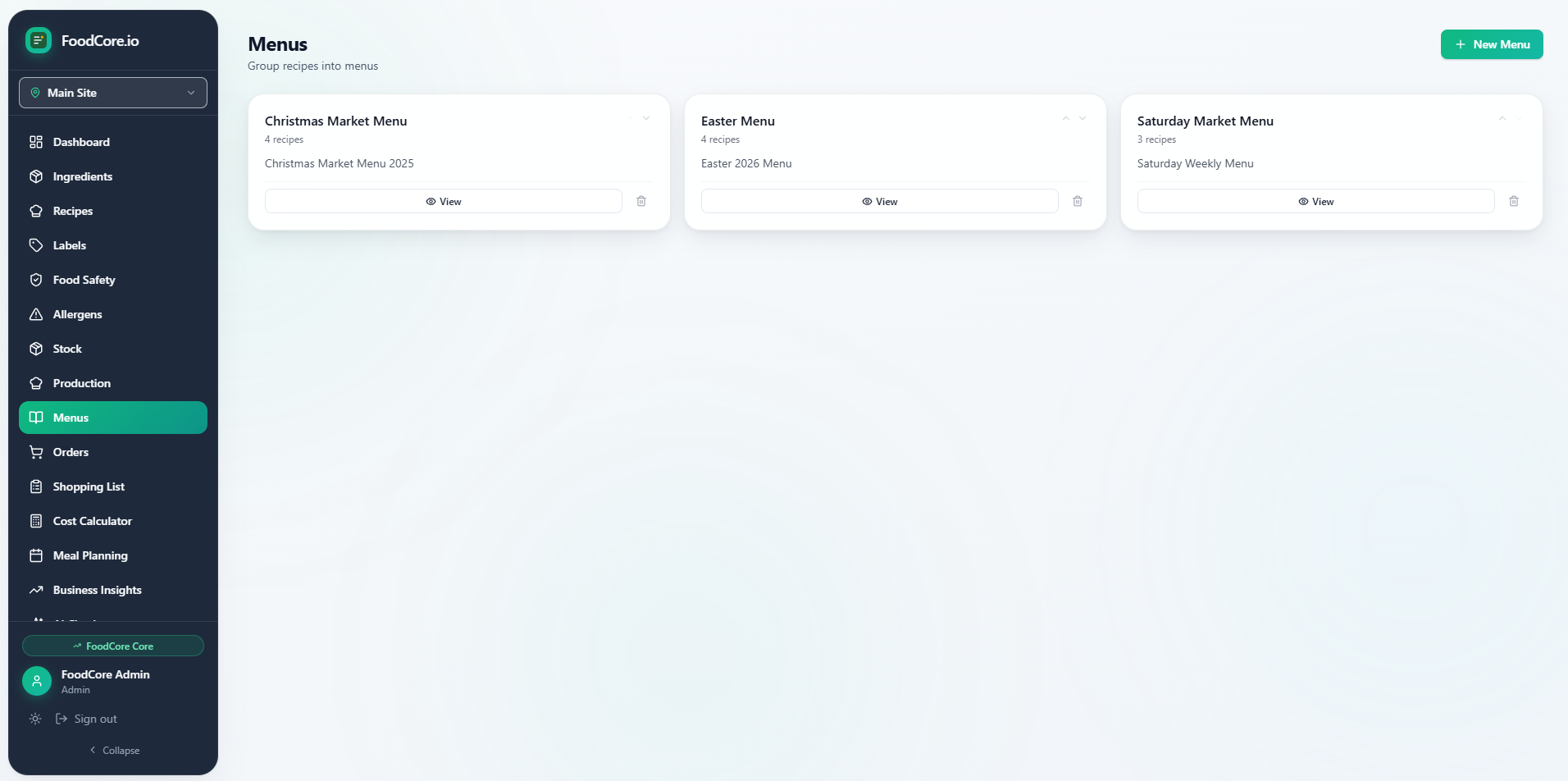
FoodCore menus — event planning with allergen and cost data built in
The three things catering recipe software must handle
1. Recipe scaling for variable guest counts
This is the most basic requirement and the one most manual systems fail at. You have a recipe for beef bourguignon that serves 8. You're catering a corporate lunch for 65. You need to scale every ingredient quantity, recalculate the total cost, and generate a shopping list — all for a specific event, not your standard batch size.
In FoodCore, scaling is automatic. Enter the number of portions required and every ingredient quantity, cost, and shopping list item recalculates instantly. You can scale any recipe to any number of portions without touching a calculator or a spreadsheet formula.
2. Per-event allergen management
A wedding with 80 guests might have 12 different dietary requirements: three guests with nut allergies, two who are coeliac, one with a shellfish allergy, several vegetarians, a vegan. Managing this manually — cross-referencing each dish against each guest's requirements — is time-consuming and error-prone.
FoodCore tracks all 14 UK-required allergens at the ingredient level across your entire recipe library. For any event, you can generate an allergen matrix showing which dishes contain which allergens. When a guest asks whether the salmon en croûte contains gluten, you have an accurate, up-to-date answer immediately — not a best guess based on a spreadsheet you last updated three months ago.
3. Job costing for accurate quoting
Underquoting a catering job isn't a margin problem — it's a direct financial loss. You've committed to delivering food at a price that doesn't cover your costs. For a small catering business, one badly priced event can wipe out a month's profit.
Accurate job costing requires knowing the current cost of every ingredient in every dish on the menu, scaled to the number of portions required. FoodCore calculates this automatically. When ingredient prices change — and they do, constantly — every recipe recalculates. You're always quoting based on current costs, not what things cost when you last updated your spreadsheet.
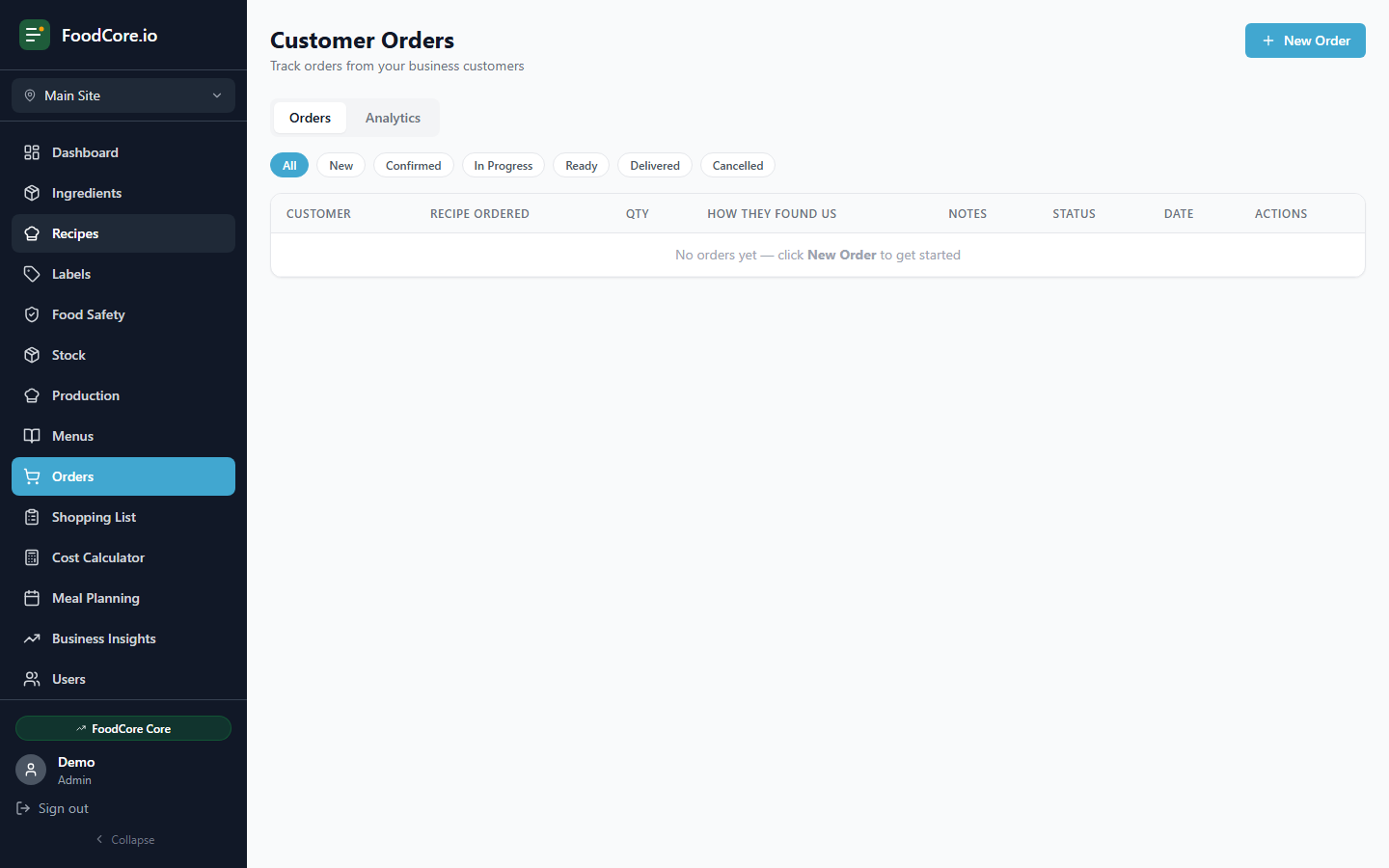
FoodCore orders — track what's been booked and what needs to be produced
What to look for in catering recipe software
Not all recipe software handles the catering use case well. When evaluating options, look for:
- Flexible recipe scaling — scale to any number of portions, not just fixed batch sizes
- Allergen matrix generation — per-event allergen information across your full menu, not just per-product labels
- Real-time cost calculation — costs that update automatically when ingredient prices change, so quotes are always based on current data
- Shopping list generation — supplier-filtered ingredient lists calculated from your event schedule, not manually totalled
- Order management — track bookings, production requirements, and delivery schedules in one place
The tools caterers actually use — and why most don't work
Most small catering businesses use a combination of spreadsheets, a recipe folder, and a separate system for bookings. The spreadsheet handles costs (until it doesn't), the recipe folder handles production, and the booking system handles clients. None of them talk to each other.
Enterprise catering software like Kafoodle or Nutritics handles the integration — but neither publishes public pricing, both quote per organisation, and the complexity is designed for large operations with dedicated admin staff. A small catering business doesn't need a system built for a hospital kitchen or a hotel chain.
FoodCore is built for small catering businesses: from £25/month, with the £65/month Core plan including every feature and no per-seat fees. The same system handles recipe costing, allergen management, food labels, shopping lists, and order tracking. One change flows through everything — update an ingredient price and every event quote recalculates automatically.
The difference between a bakery and a caterer using FoodCore: a bakery generates the same shopping list every week with minor variations. A caterer generates a completely different shopping list for every event, scaled to a specific guest count, filtered by supplier. FoodCore handles both — the scaling and supplier filtering are automatic.
A note on restaurants
Small restaurants have similar needs to caterers — recipe costing, allergen management, and menu planning — but with the added complexity of a fixed menu that changes seasonally rather than per-event. FoodCore's recipe library and allergen matrix work well for restaurant menus: build your dishes once, track costs as ingredient prices change, and maintain accurate allergen information for front-of-house staff and customers.
For restaurants that also sell pre-packed products — meal kits, takeaway items, deli products — FoodCore's Natasha's Law label generation covers that too.