What's the Best Software for Managing a Small Bakery? An Honest Answer
At some point, every growing bakery hits a wall. The spreadsheets start creaking. The paper order lists go missing. Someone prices a new product based on guesswork and sells it at a loss for three months before anyone notices. That's the moment the question gets Googled: what's the best software for managing a small bakery? Here's an honest, practical answer. See our guide to choosing software for a home baking business.
First: what does "bakery management" actually cover?
Before you can evaluate any software, it helps to be clear about what you're trying to manage. Bakery management isn't one thing — it's a collection of interconnected operational challenges that compound when you try to handle them with separate, disconnected tools.
In practice, managing a small bakery means:
- Recipes and ingredients — knowing exactly what goes into every product, at what quantity, and what it costs
- Stock levels — knowing what ingredients you have, what you've used, and what you need to order
- Allergen information — knowing which allergens are in every product, automatically, based on the ingredients used
- Production planning — knowing what to make, when to make it, and whether you have the ingredients to do so
- Supplier ordering — generating accurate purchase requirements without spending your Monday morning writing the same list by hand
- Pricing — knowing what each product actually costs to make so you can price it profitably
The best bakery management software for a small operation handles all of these things — and crucially, keeps them connected. When you update an ingredient cost, it should flow through to every recipe automatically. When you produce a batch, stock should update without you touching a spreadsheet. When you add a new ingredient, its allergens should appear in every recipe that uses it.
This integration is what separates purpose-built bakery software from a collection of generic tools that sort of cover the same ground separately.
The spreadsheet phase — and exactly when it breaks
Almost every small bakery goes through a spreadsheet phase. It's rational: spreadsheets are free, flexible, and you already know how to use them. For the first few products, they're genuinely fine. You have a tab for recipes, a tab for ingredient costs, maybe a tab for stock. It works.
The spreadsheet phase breaks at a predictable point: when your product range grows past about fifteen to twenty items, or when your team grows past one or two people. At that point, maintaining the spreadsheet starts to cost more time than it saves. Cells go out of sync. Someone updates the butter price in one tab but forgets to update the formula in another. A new member of staff doesn't know which version of the recipe spreadsheet is current.
The other failure mode is that spreadsheets don't enforce accuracy. They're a blank canvas — which means they're only as good as whoever is filling them in. A formula error, a missed decimal point, an ingredient that someone forgot to add — and suddenly your costs are wrong, your stock count is fiction, and your pricing decisions are based on data you can't trust.
If this sounds familiar, you're not doing it wrong. You've just hit the natural ceiling of what spreadsheets can do.
What to look for in bakery management software
When you start evaluating options, the temptation is to compare feature lists. Resist it. A longer feature list doesn't mean a better product for a small bakery — it often means the tool was built for a different kind of customer and has been stretched to cover yours. Focus on these criteria instead:
Integration: does everything connect?
The single most important question. When you update an ingredient, does the change flow through to every recipe automatically? When you mark production complete, does stock update? When you build a new recipe, do allergens populate from the ingredients you've chosen? If the answer to any of these is "no, you have to update it manually", the tool is a dressed-up spreadsheet, not a management system.
Is it built for small businesses, or scaled down from an enterprise product?
Enterprise kitchen management tools exist, and some of them are genuinely excellent — for the operations they were built for. A chain of fifty restaurants with a central procurement team and a dedicated systems administrator. That is not a small bakery. Software built for enterprise operations tends to be complex, expensive, and slow to onboard. It solves problems you don't have while making the problems you do have harder to fix. Look for a tool that describes its target customer in terms that sound like you.
Transparent pricing with no per-user fees
Some tools look affordable until you try to add your second team member and discover the per-seat pricing. Others have a low entry price that locks core features behind a higher tier. For a small bakery team, the right model is a single flat price that includes all features and doesn't charge extra as your team grows. You should know exactly what you're paying before you sign up — no surprises.
A trial period that's long enough to actually test it
You cannot evaluate bakery management software in a day. You need to set up your ingredient library, build a few recipes, run a production week, and see whether the stock tracking works the way you expect. A seven-day trial is the minimum that makes this possible. If a tool only offers two or three days, they know it won't survive proper evaluation.
What's out there: a practical overview
The market for small bakery management software includes a handful of genuinely useful tools and a much larger number of generic alternatives that almost-but-don't-quite fit. Our ranked comparison of kitchen management software UK 2026 covers the full list with honest assessments of each. The short version:
- Spreadsheets — free, familiar, and fine until they're not. They don't cascade changes, don't update stock automatically, and have no allergen management. A starting point, not a long-term solution.
- Recipe costing tools (Jelly, similar) — strong on nutritional analysis and recipe costing, weaker on inventory and production management. Good if costing is your primary need and you're comfortable managing stock separately.
- Enterprise kitchen platforms (ChefDesk, Kafoodle, Nutritics) — built for larger operations. Often quote-based pricing, complex onboarding, and features you'll never use. Not designed for a two-to-ten person bakery team.
- All-in-one platforms built for small operations (FoodCore.io) — covers recipes, costs, allergens, stock and supplier orders in a connected system at a price point built for small businesses.
Our guide to recipe management software for small bakeries goes deeper on the recipe and costing side of this decision if that's where you want to start.
FoodCore.io: how it covers the full picture for a small bakery
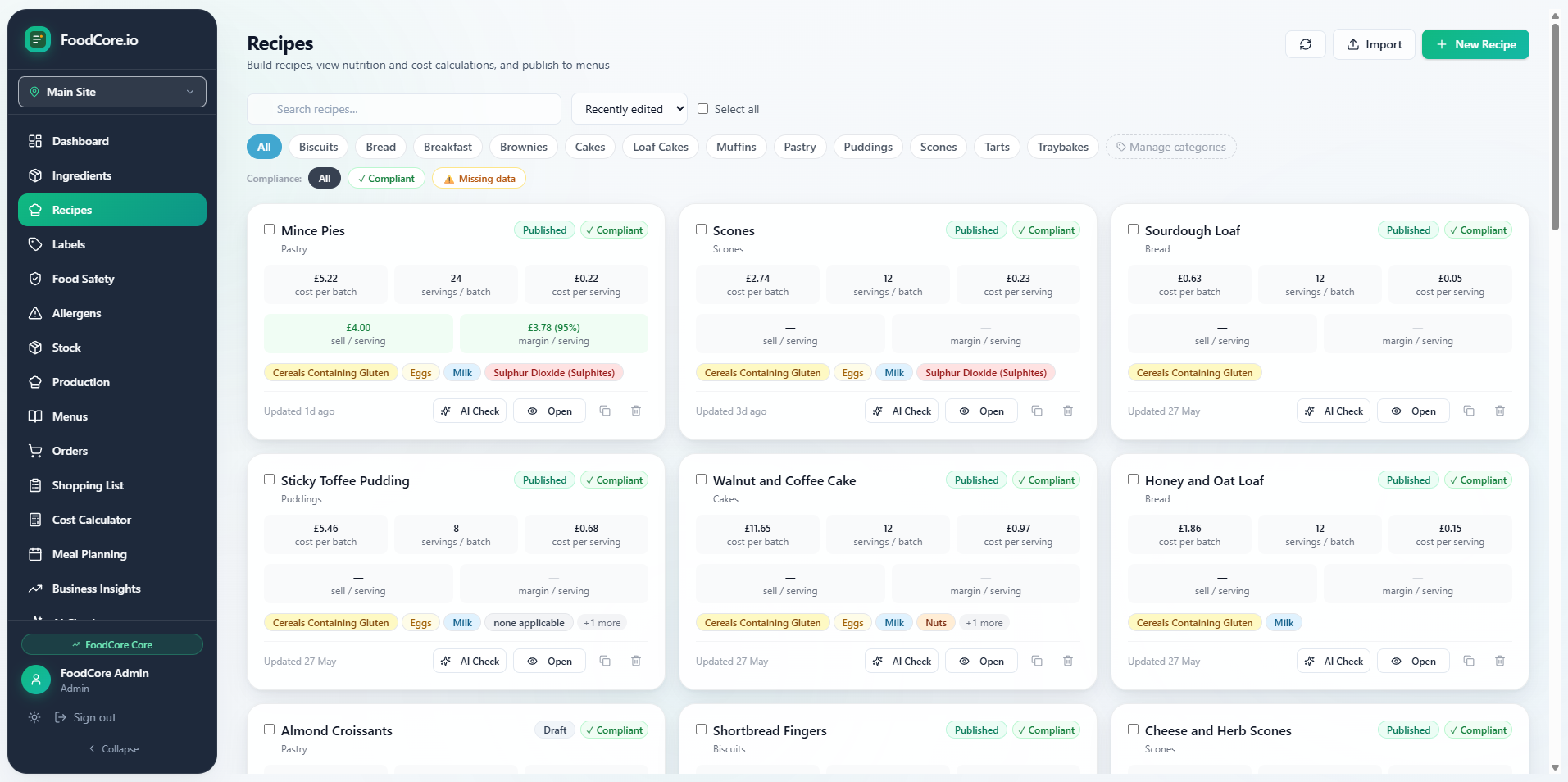
FoodCore.io's bakery management software is built around the idea that every part of running a small food business should be connected in one place. Here's how that works in practice:
- Ingredient library — every ingredient with its cost per gram or unit, its allergen information, and its supplier. Build it once and it feeds every other part of the system.
- Recipe management — build recipes from your ingredient library. Costs calculate automatically. Allergens populate automatically. Yields and batch sizes are built in.
- Stock tracking — mark a batch as produced and ingredients deduct automatically. Add a delivery and stock updates immediately. Set thresholds and get flagged when something runs low.
- Supplier shopping lists — generate a purchase list from your current stock levels and planned production, filtered by supplier, ready to send.
- Allergen management — from ingredient to recipe to customer-facing label, allergen data flows through automatically. No manual re-entry at each stage.
Pricing is simple — one monthly or annual fee per plan, from £25/month, with no per-user charges. The trial is seven days, which is enough time to set up your core products and run a real production week.
A real-world example: what the transition looks like
Consider a five-person bakery supplying wholesale accounts and a weekend market. They were running on a combination of spreadsheets and a shared Google Doc that someone had to update manually after every production run. The owner was spending most of Sunday evening preparing the weekly supplier order by hand — checking the spreadsheet, guessing what they'd need for the week ahead, and writing out separate lists for each supplier.
After moving to purpose-built software, the Sunday evening order process dropped from around ninety minutes to under twenty. Stock updated automatically during the week as batches were produced. Low stock alerts flagged two ingredients they'd been consistently under-ordering. And for the first time, they had accurate cost data on every product in their range — which revealed that their gluten-free brownie, their most labour-intensive product, had been priced significantly below its actual ingredient cost.
The change didn't require a systems implementation project. It required a Saturday afternoon to set up the ingredient library and recipes, and a single production week to verify the stock tracking was working correctly. By the end of the first month, the team agreed it was one of the most straightforward operational improvements they'd made.
Common mistakes when choosing bakery management software
A few patterns come up repeatedly when small bakeries make poor software choices:
- Choosing on price alone — the cheapest option is rarely the right option. A tool that costs nothing but requires constant manual maintenance has a high real-world cost in time and errors.
- Choosing on feature count — more features are not better if they're features you'll never use. Complexity that doesn't serve you is just friction.
- Not testing with real production data — setting up demo data during a trial tells you almost nothing about whether the tool will work for your actual operation. Use your real recipes and real ingredients.
- Expecting instant migration — moving from spreadsheets to dedicated software takes a few hours of setup time. Plan for it and it's manageable. Expect it to happen automatically and you'll be disappointed.
FoodCore is kitchen management software for small UK food businesses — recipe costing, allergen tracking, stock management and supplier shopping lists, all in one place.
Start free trial →