What's the Easiest Way to Track Food Allergies for Your Restaurant?
Food allergy management is one of the areas where getting it wrong has consequences that go well beyond a bad review. For any food business selling directly to the public, accurate allergen information isn't optional — it's a legal requirement and a matter of customer safety. The good news is that tracking allergens doesn't have to be complicated. Here's the most practical and reliable way to do it.
Why allergen management matters more than ever
Approximately 2 million people in the UK have a diagnosed food allergy. For someone with a severe allergy, eating a food that contains an allergen they weren't warned about can trigger anaphylaxis — a life-threatening reaction. Every year in the UK, people are hospitalised and, in the most serious cases, die as a result of allergic reactions to food they were not accurately informed about.
For food businesses, the legal and reputational consequences of an allergen incident are severe. But the case for taking allergen management seriously isn't primarily a legal one — it's a human one. Your customers trust you with their safety when they buy from you. That trust requires that the allergen information you provide is accurate, current, and communicated effectively every time, not just most of the time.
Our comprehensive guide to allergen management for food businesses covers the full picture. This article focuses specifically on the practical question of how to track allergens effectively — and how to make it as simple and reliable as possible.
What UK law requires
UK food allergen law requires that food businesses declare the presence of 14 major allergens whenever they appear in any food product. For food sold pre-packaged for direct sale — a product packaged on the premises and sold from the same premises, like a bagged sandwich from a café counter or a boxed cake from a bakery — Natasha's Law (which came into force in October 2021) requires that the full ingredient list and all allergens be printed on the label.
Our complete guide to Natasha's Law covers the requirements in full. The short summary: if you sell any food that you've packaged on your own premises, every allergen in every product must be declared in writing on the packaging — not just communicated verbally, not just listed on a board, but on the label of the product itself.
The 14 major allergens you must track
UK allergen law requires declaration of the following 14 allergens wherever they appear:
- Cereals containing gluten (wheat, rye, barley, oats)
- Crustaceans (prawns, crab, lobster)
- Eggs
- Fish
- Peanuts
- Soybeans
- Milk (including lactose)
- Nuts (almonds, hazelnuts, walnuts, cashews, pecans, Brazil nuts, pistachios, macadamia nuts)
- Celery
- Mustard
- Sesame
- Sulphur dioxide and sulphites
- Lupin
- Molluscs (mussels, oysters, squid)
Every one of these must be tracked for every ingredient in every product you sell. The challenge isn't knowing which allergens to declare — it's making sure the information stays accurate across your full product range, every time a recipe changes, every time you switch supplier, and every time a new product is added.
Why verbal communication and handwritten notes fail
In many small food businesses, allergen management still relies heavily on verbal communication. A customer asks "does this contain nuts?" and a staff member answers from memory or calls through to the kitchen. This is the highest-risk approach to allergen management, for several interconnected reasons.
First, memory is fallible. Staff who know a product well may give accurate answers most of the time — but "most of the time" is not an acceptable standard for information that can be life-or-death. Second, verbal communication leaves no record. If an incident occurs, there is no documentation that correct information was given. Third, staff turnover means that institutional knowledge about allergens is constantly being lost and rebuilt — a new team member doesn't automatically know that the house dressing contains mustard.
Handwritten allergen lists and printed menus with allergen columns have the same problem from a different angle: they go stale the moment a recipe or ingredient changes, and there's no mechanism to ensure they get updated before the next service. A handwritten note that was accurate last Tuesday is a liability if the recipe changed on Wednesday and the note wasn't updated.
How spreadsheet-based allergen tracking breaks down
Spreadsheets are a step up from verbal communication and handwritten notes — they're structured, shareable, and can cover your full product range. But they have a critical weakness in the context of allergen management: they're manually maintained, which means they're only accurate when someone has actively kept them up to date.
The specific failure modes are predictable. A new ingredient is added to a recipe but the allergen spreadsheet isn't updated to reflect it. A supplier changes a formulation, adding a new allergen to an ingredient your business uses in multiple products — if you notice the change at all, you have to manually find and update every product that uses that ingredient. An ingredient is swapped for a similar one that happens to contain a different allergen, and the change is recorded in the recipe notes but not propagated to the allergen records.
None of these failures are the result of negligence or bad intentions. They're the result of a system that requires constant, perfect manual maintenance across an expanding and changing product range. That system will fail eventually. The question is when, and whether the failure will be caught before it becomes an incident.
What proper allergen management software does differently
The fundamental difference between manual allergen tracking and software-based allergen management is where the data lives and how it flows. In a manual system, allergen information exists in multiple places — supplier data sheets, recipe notes, a spreadsheet, printed menus — and has to be kept in sync by hand. In a software-based system, allergen information lives in one place — the ingredient library — and flows automatically to every recipe and product that uses each ingredient.
Our allergen matrix software page covers how this works in detail. The practical implication is this: when a supplier changes a formulation and you update the ingredient in your system, every product containing that ingredient automatically reflects the updated allergen information. You don't have to find every affected product manually. You don't have to trust that someone will remember to update the allergen sheet. The system handles it, and it's correct everywhere, immediately.
Beyond automatic propagation, good allergen management software generates customer-facing allergen outputs — printed labels, allergen matrices for menus, and reports — directly from the same data. Because everything derives from the same ingredient library, the label that goes on the product always matches the allergen information in the system. There's no reconciliation step, no manual check to see if the label matches the recipe. They're the same data, expressed in different formats.
How FoodCore.io handles allergens from ingredient to label
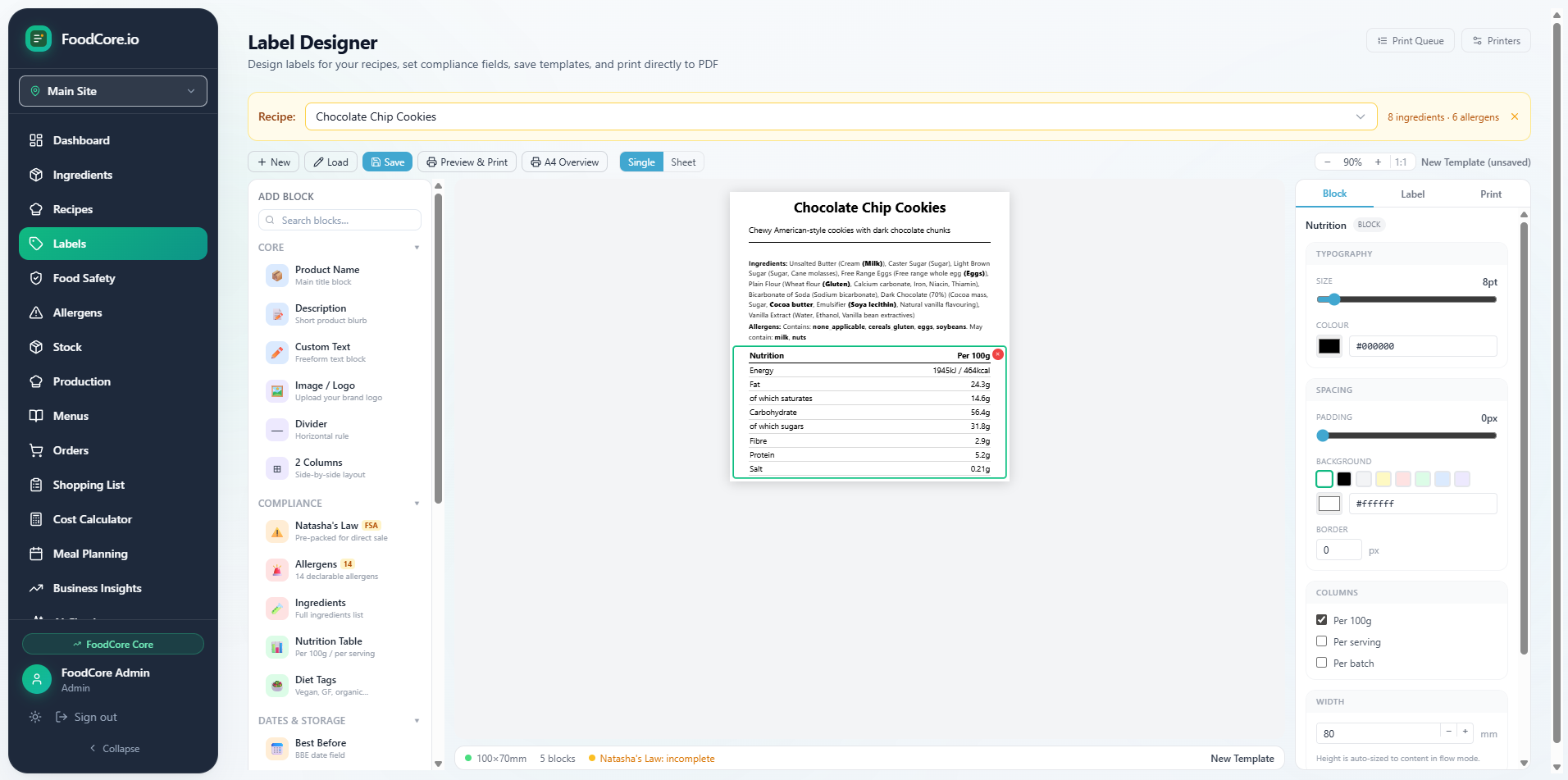
FoodCore.io's allergen management works through the ingredient library that powers every other part of the system. Every ingredient is stored with its allergen flags. When you build a recipe, you select ingredients from that library. The allergens in the recipe are calculated automatically from the ingredients used — you don't enter allergen information at the recipe level, because you don't need to. It's inherited from the ingredients.
When a recipe changes — an ingredient swapped, a quantity adjusted, a new component added — the allergen information updates automatically. When a supplier changes a product formulation and you update the ingredient, every recipe using that ingredient reflects the change immediately. The system maintains the accuracy of your allergen data continuously, without requiring manual intervention at every stage.
Labels can be generated directly from the recipe data. The ingredient list and allergen declarations on the label come from the same data that powers the recipe management and costing features — which means the label is always in sync with the recipe, as long as the recipe is maintained in the system. For businesses selling PPDS food — food pre-packaged for direct sale — this is how Natasha's Law compliance becomes manageable rather than burdensome.
A real-world example: an allergen near-miss that prompted a rethink
Consider a small bakery selling packaged baked goods from its counter. Their allergen information was maintained on a printed sheet updated whenever a recipe changed — in practice, whenever someone remembered to update it. When they introduced a new granola bar that contained sesame seeds, the recipe was added to their baking notes but the allergen sheet wasn't updated for three days. During those three days, the granola bar was on sale. A customer with a sesame allergy asked about allergens; the member of staff consulted the sheet and said sesame wasn't present. The customer bought the product.
Fortunately, the customer checked the ingredient label more carefully before eating the bar and noticed the sesame seeds listed as an ingredient. They didn't consume the product and returned it. The bakery owner discovered the error, updated the allergen sheet immediately, and — shaken by how close the situation had come to a serious incident — switched to software-based allergen management within the week.
With the software in place, the process is now: add the new ingredient with its allergens, build the recipe, and generate the label. The allergen information is correct from the moment the product is set up in the system, not after a separate manual update that might happen today or might slip until Thursday.
The staff training dimension
Software handles the data side of allergen management — keeping information accurate, generating labels, producing allergen matrices. But customer-facing allergen communication still involves people. Staff training is the human complement to the software layer, and both are necessary.
The most important things staff need to know are:
- Where to find accurate allergen information (the system, not memory)
- What to say when a customer asks about allergens: always check the system rather than answering from memory, even for products you know well
- What to do if you're not certain: escalate to someone who can check, never guess
- What to do if a recipe or ingredient changes: log it in the system before the product is sold, not after
- Cross-contamination risks: software tracks declared allergens in recipes, but physical cross-contamination in the kitchen is a separate operational control that requires separate procedures
Good allergen management is a combination of accurate data, reliable processes and informed people. Software solves the data problem reliably and consistently. Training solves the people problem. Together, they give your customers — and your business — the protection they deserve.
Getting started: the practical approach
Moving from manual allergen management to software-based management feels like a big project when you look at the whole thing. In practice, it starts with your ingredient library: enter your ingredients, flag their allergens, and link them to your existing recipes. For most small food businesses, this can be done in a day or two. From that point, the system maintains accuracy automatically as recipes change and new products are added.
The one-time setup cost — in time, not money — is the price of having allergen information you can actually trust. For any business selling food to the public, that's not a cost to be avoided. It's a responsibility to be met, as simply and reliably as possible. Good software makes it both.
FoodCore is kitchen management software for small UK food businesses — allergen tracking from ingredient to label, recipe costing, stock management and supplier shopping lists.
Start free trial →