What Kitchen Management Software Actually Saves Time?
Kitchen management software promises to save time. But where does the time actually come from? Here's an honest breakdown of the three tasks that eat the most hours in small food businesses — and how software eliminates them.
The honest number: 30–40 hours a month
That's the admin time small food businesses typically recover when they switch from manual systems to FoodCore. It sounds like a lot. But when you break down where the time actually goes, it adds up quickly.
The time doesn't come from one big task. It comes from three recurring tasks that each take longer than they should, happening every week:
- Writing shopping lists — manually totalling ingredient quantities across recipes before every order
- Maintaining food labels — finding the file, updating it, reformatting, reprinting every time a recipe changes
- Recalculating recipe costs after supplier price changes
None of these tasks is complicated. All of them are repetitive. And all of them are completely automatable — which is exactly what kitchen management software does.
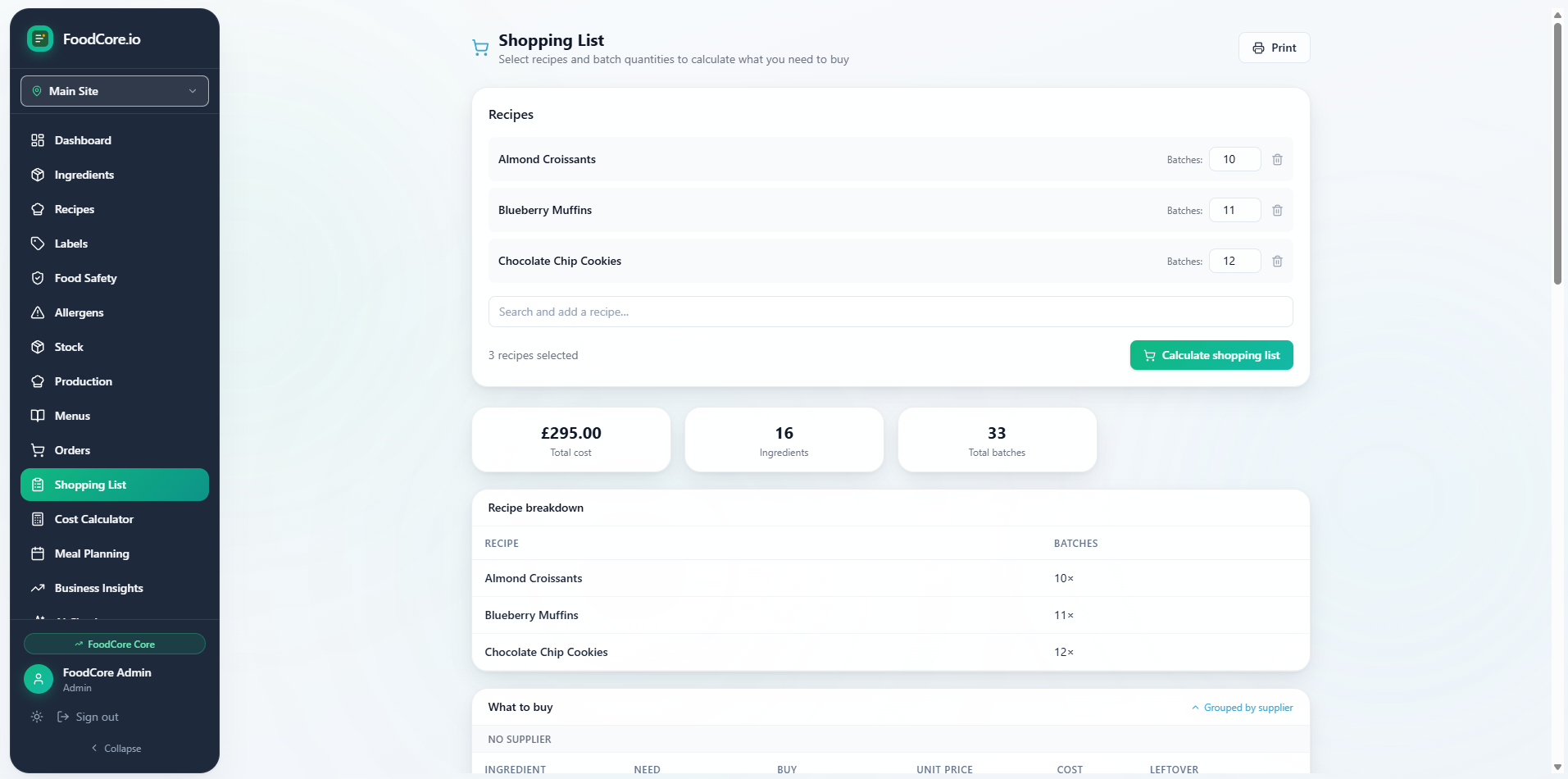
FoodCore shopping lists — supplier-filtered, calculated from your production plan in one click
Where the time actually goes: shopping lists
For a food business making 15–20 different products, writing a shopping list for a week's production means going through every recipe you plan to make, totalling up the quantities of each ingredient, and then checking what you already have in stock. If you buy from multiple suppliers, you then need to split the list by supplier.
For a business with 20 products and 50 ingredients across 4 suppliers, this is easily an hour of work. Every week. That's 4+ hours a month just on shopping lists.
In FoodCore, this takes seconds. You enter your production plan — what you're making and how many — and FoodCore generates a shopping list automatically, filtered by supplier, with quantities calculated from your recipes and adjusted for current stock levels. The moment most customers say FoodCore is worth it is the first time they do this. An hour of work becomes a single click.
Where the time actually goes: food labels
If you sell pre-packed products, you need a Natasha's Law compliant label for every product. Most small food businesses maintain these in Word or Canva — one file per product. When a recipe changes, you find the file, update the ingredients list, recheck the allergens, reformat to fit the label, and reprint.
For a business with 25 products, even one recipe change per week means 25 potential label updates. In practice, most businesses let labels drift — updating them in batches when they remember, or when a customer asks about an ingredient. That's a compliance risk as well as a time cost.
In FoodCore, labels are generated from recipe data. Change a recipe and the label updates automatically. There's no separate file to maintain, no reformatting, no risk of selling a product with an outdated label. The time saving is real — but so is the compliance benefit.
Where the time actually goes: recipe costing
Ingredient prices change constantly. Flour, butter, eggs, chocolate — commodity prices shift with seasons and supply chains. Every price change from a supplier potentially affects multiple recipes. In a spreadsheet, updating costs means finding every recipe that uses the affected ingredient and updating the formula manually.
For a business with 25 recipes and a supplier who raises prices on 5 ingredients at once, that's potentially 25 × 5 = 125 manual updates. In practice, most businesses don't do this — they update the most important recipes and let the others drift. The result is a cost spreadsheet that's partially accurate and partially out of date, which means pricing decisions are based on incomplete information.
In FoodCore, update a supplier price once and every recipe that uses that ingredient recalculates automatically. The margin dashboard updates in real time. You always know your current cost of production.
One gluten-free bakery using FoodCore reduced their admin time significantly after switching. The time they got back didn't go into more admin — it went into marketing and baking. The result was more revenue, not just less time at a desk.
What kitchen management software doesn't save time on
It's worth being honest about what software doesn't fix. Kitchen management software saves time on repetitive, data-driven tasks — costing, labelling, shopping lists. It doesn't save time on the actual cooking, on customer relationships, or on the creative work of developing new products.
It also doesn't save time if you don't use it consistently. The value of FoodCore comes from keeping your ingredient library current, logging production so stock levels stay accurate, and updating prices when suppliers change them. If you set it up and then stop maintaining it, the data drifts and the time savings disappear.
The businesses that get the most from kitchen management software are the ones that treat it as their operational system of record — the place where ingredient data, recipe data, and production data all live. When everything is in one place and kept current, the time savings are automatic.
The calculation: is it worth £65/month?
If kitchen management software saves you 30 hours of admin per month and you value your time at £15/hour, that's £450/month of recovered time. FoodCore costs £65/month. The maths is straightforward.
But the more useful framing is opportunity cost. Those 30 hours aren't just wasted — they're hours not spent on marketing, on developing new products, on building customer relationships, on the things that actually grow the business. That's the real cost of manual admin: not just the time, but what you could have done with it.