What Software Should I Use to Manage My Bakery?
There's no shortage of software options for bakeries. The harder question is which one is actually built for a small operation — and whether the cost and complexity are worth it. Here's an honest breakdown. See our guide to choosing software for a home baking business.
The honest answer: it depends on what's actually breaking
Most bakery owners searching this question aren't starting from scratch. They already have something — a spreadsheet, a folder of Word documents, a notes app, a combination of all three. What they're really asking is: what do I replace this with, and is it worth the hassle?
The answer depends on which part of your operation is causing the most pain. But in our experience working with small UK bakeries, the problem is almost never one thing. It's the combination: costs tracked in one place, allergen information in another, labels in a third, orders in a fourth. Nothing talks to anything else. Every change in one place requires manual updates everywhere else.
That fragmentation is the real problem. And it's why the solution isn't a better spreadsheet — it's a single system where everything is connected.
What a small bakery actually needs from software
Before comparing tools, it's worth being clear about what a bakery actually needs to manage day-to-day. Most bakeries need five things:
- Recipe costing — knowing what each product costs to make, and having that update automatically when ingredient prices change
- Allergen tracking — accurate allergen information across every recipe, especially critical for bakeries with gluten-free or nut-free ranges
- Food labels — Natasha's Law compliant PPDS labels for every pre-packed product, updated when recipes change
- Shopping lists — knowing what to order before each production run, calculated from your recipes rather than estimated from memory
- Order management — tracking customer orders and what needs to be produced each day or week
The question is whether you want five separate tools for these five things, or one system that handles all of them together.
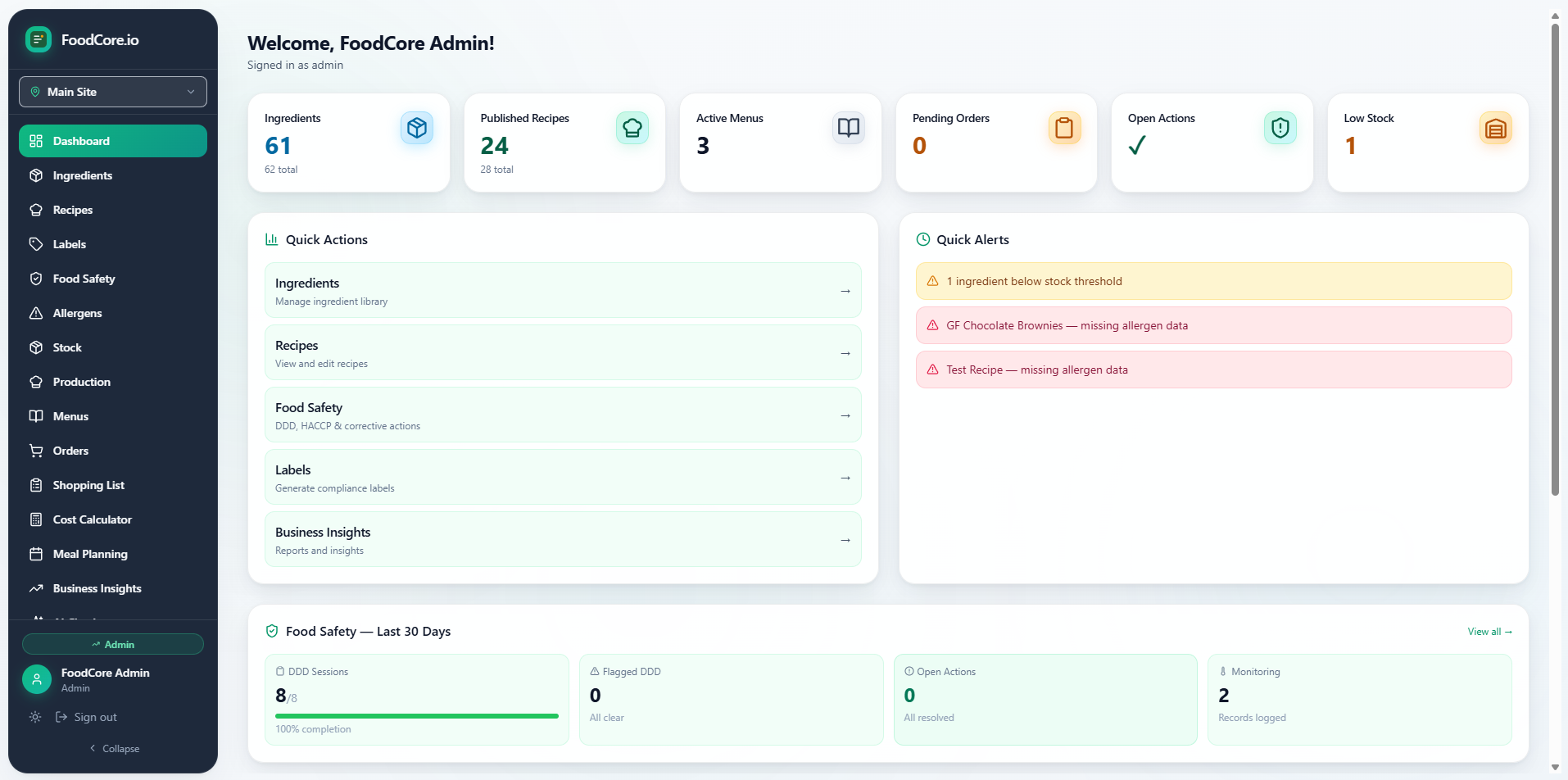
FoodCore dashboard — recipe costs, margins, and production at a glance
The options: what's actually available for small bakeries
Spreadsheets (Excel / Google Sheets)
Free, familiar, and flexible. Most bakeries start here. The problem isn't that spreadsheets are bad — it's that they're disconnected. Your costing spreadsheet doesn't know about your allergen spreadsheet. Your label template doesn't know about your recipe. When something changes, you update one file and hope you remember to update the others.
Spreadsheets also break in predictable ways: formulas that stop working when you add a row, version conflicts when two people edit the same file, and the slow drift of data that was accurate six months ago but hasn't been updated since.
Enterprise catering software (Kafoodle, Nutritics, Lightspeed)
These platforms are built for large catering operations, restaurant chains, and food manufacturers. They're comprehensive — but they're priced and designed for organisations with dedicated admin staff and IT support. Kafoodle and Nutritics are quote-priced rather than published, and have feature sets that a small bakery will never use. They're not built for a one-person operation that needs to cost a new recipe at 6am before the morning bake.
FoodCore
FoodCore is built specifically for small UK food businesses — bakeries, caterers, home bakers, market stall sellers. From £25/month it covers recipe costing, allergen tracking and Natasha's Law labels; the £65/month Core plan adds shopping lists and order management. No per-seat fees.
The key difference from enterprise tools isn't just price — it's that FoodCore is built with small food businesses, not for a market segment. Features are developed in collaboration with actual customers who test them before release. That means the tool reflects how small bakeries actually work, not how a product manager imagined they might.
One FoodCore customer — a gluten-free bakery — reduced their admin time significantly after switching. With allergen accuracy being existential for a gluten-free operation, having everything connected in one system meant they could trust their data. The time they got back went into marketing and baking — and ultimately into more revenue.
The case for one connected system
The moment most bakery owners say "this is worth it" with FoodCore isn't the first time they generate a label or cost a recipe. It's the first time they update a supplier price and watch every recipe that uses that ingredient recalculate automatically. Or the first time they generate a supplier-filtered shopping list for a full week's production in a single click — no manual totalling, no cross-referencing recipes.
That's what a connected system does that a collection of spreadsheets can't: one change flows through everything. Update an ingredient, and the cost, the label, the allergen matrix, and the shopping list all update with it. The administrative overhead of keeping multiple systems in sync disappears.
What to look for when choosing bakery software
- Is everything connected? Recipes, costs, allergens, and labels should all live in the same system and update together
- Is it priced for your scale? Per-seat fees and feature tiers add up quickly for small operations
- Can you get started quickly? Barcode scanning for ingredient import means most bakeries can have their library built in an afternoon, not weeks
- Does it handle Natasha's Law? If you sell pre-packed products, compliant PPDS labels are non-negotiable
- Is it built for small businesses? Enterprise tools have complexity you don't need and miss workflows you do