Affordable Bakery Management Software for Small Teams
Most small bakery teams assume specialist software is out of their reach — a tool for bigger operations with bigger budgets. That assumption is costing them hours every single week. Here's what affordable bakery management software actually looks like, what a small team genuinely needs, and how to find the right fit without getting distracted by features you'll never use.
The cost objection — and why it usually doesn't hold up
Talk to almost any small bakery owner about management software and you'll hear the same thing within sixty seconds: "It's probably too expensive for a business our size." It's an understandable instinct. The software industry spent decades positioning enterprise tools as aspirational, and small business owners have learned to expect pricing that doesn't match their reality.
But that instinct doesn't hold up in 2026. A new generation of tools has been built specifically for small food businesses — not stripped-down versions of enterprise platforms, but software designed from the ground up for teams of two to ten people. The pricing reflects that design intent. The real question isn't whether you can afford bakery management software. It's whether you can afford to keep operating without it.
The cost of managing a bakery on spreadsheets and sticky notes isn't the software licence you're saving — it's the hours you're losing to admin every week that could be spent baking, developing new products, or actually growing the business. When you run that calculation honestly, the numbers almost always point in the same direction.
What "affordable" really means for a small team
Affordable isn't the same as cheap. A tool that costs very little but requires ten hours of setup, ongoing manual data entry, and frequent error-correction isn't affordable — it just moves the cost from your monthly invoice to your working hours. That's a worse deal, not a better one.
For a small bakery team, affordable means all of the following being true:
- Transparent, flat pricing — you know exactly what you're paying each month, with no surprise charges for adding a team member or unlocking a feature mid-subscription
- No per-user charges — you shouldn't have to choose between giving your whole team access and keeping costs manageable
- All core features included from the start — the tool does what you actually need on day one, without funnelling you into a higher tier for basic functionality
- Fast, low-friction onboarding — you should be up and running in a few hours, not days or weeks of configuration
- Time savings that outweigh the subscription cost — if the tool saves you three hours of admin a week, it's earning its keep many times over
A tool that ticks all of these feels affordable regardless of its monthly price, because it returns more value than it consumes. One that's technically cheap but slow, confusing, or limited will feel expensive no matter what it costs, because it never stops costing you time.
The hidden cost of running without proper software
Most small bakery owners have a rough sense of how much time they spend on admin. What they often fail to account for is the compounding effect. When you're manually updating a spreadsheet every time you use an ingredient, cross-referencing costs every time you price a new product, and relying on memory for stock levels — each task takes longer than it should, errors accumulate quietly, and the decisions you're making are based on information that's already out of date.
The most common consequences of running without dedicated software are:
- Underpriced products — estimating rather than calculating food costs means most small bakeries are undercharging on at least a handful of products. If your bestselling loaf is priced just £1 below its true cost and you sell forty a week, that's over £2,000 a year in invisible losses.
- Ingredient waste from over-ordering — without accurate stock tracking, you order what you think you need rather than what you actually need. Butter, eggs, and specialty ingredients sit unused past their best before date.
- Production stoppages from under-ordering — the flip side. Running out of a key ingredient mid-production week because nothing flagged the low stock in advance.
- Admin time that should be baking time — writing order lists by hand, manually calculating recipe yields, updating spreadsheets after every production run. These tasks expand to fill whatever time you give them.
Understanding your true recipe costs is the first step to fixing most of these problems. Our recipe costing guide walks through exactly how to calculate the real cost of any product — and why so many small food businesses consistently get this wrong.
What a small bakery team actually needs from software
Small teams don't need every feature in the catalogue. Feature overload is one of the main reasons small businesses adopt a piece of software and abandon it — they spend more time learning the tool than they ever spend benefiting from it. The features that genuinely move the needle for a small bakery team are much simpler than most software companies would have you believe.
A central ingredient and recipe library
Every ingredient in one place, each linked to a cost per gram or unit. Every recipe built from those ingredients, so cost calculations are automatic. When the price of flour goes up, you update it once and every recipe that uses flour reflects the new reality immediately — across your whole product range, without touching a single spreadsheet tab.
Stock that updates itself
When you mark a batch as produced, the ingredients it used should be automatically deducted from your stock levels. You see exactly what you have left without counting anything manually. When a particular ingredient drops below a threshold you've set, the system flags it — no more discovering at 6am on Saturday that you're out of vanilla extract.
Allergen data that flows through automatically
Every ingredient carries its allergen information. When you build a recipe, allergens are calculated automatically from the ingredients you've used — not entered manually, recipe by recipe. If a supplier changes a formulation, you update the ingredient once and the change flows through to every recipe that uses it. This isn't just a time saver; it's the difference between compliant allergen management and a compliance risk.
A supplier shopping list you don't have to write
Based on your current stock levels and your planned production, the system generates a shopping list. Filtered by supplier, so you can send the right requirements to each of your suppliers without reorganising a single line. No more writing the same list out week after week from memory and gut feel.
A dashboard that tells you what matters today
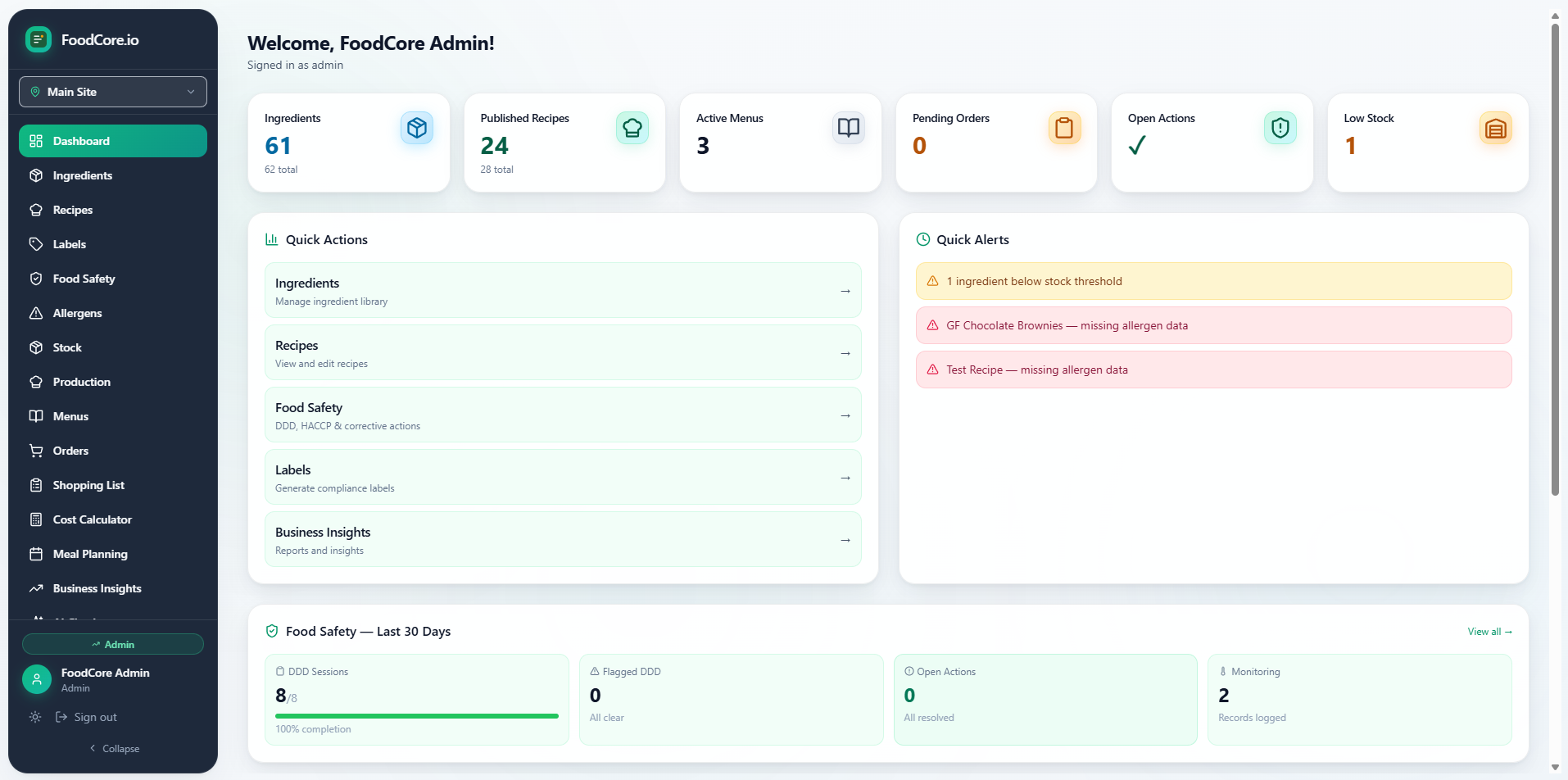
What needs ordering. What's running low. Where your production stands. Not fourteen reports and six charts — just the information you need to make decisions right now.
Features you don't need — and shouldn't pay for
Be cautious of any tool that tries to sell you on features built for operations ten times your size. Multi-site management, complex API integrations, bespoke analytics dashboards, enterprise onboarding packages — these sound impressive and they add cost, but they add zero value for a team of three baking out of a single kitchen. The right software for a small team is honest about what it's built for. Choose the tool that fits your actual operation, not the one you might theoretically have in five years.
A real-world example: what the switch looks like in practice
Consider a small artisan bakery — three people, baking five days a week, supplying a mix of local wholesale accounts and a small retail counter. Before switching to dedicated software, Monday mornings were partly swallowed up by checking what ingredients were left from the previous week, cross-referencing the week's baking schedule against those levels, and writing out delivery orders by hand. Every time a new product was added to the range, someone had to build a new spreadsheet tab, manually calculate the ingredient costs, and hunt down the allergen data from individual supplier sheets.
After switching to a purpose-built tool, that Monday morning process dropped from around two hours to under twenty minutes. The system showed them exactly what stock was available, flagged everything that needed ordering, and generated a supplier list automatically. New products were added in minutes because the ingredient library and allergen data were already there. The time saving alone — roughly six to seven hours across the team each week — was the most immediate, tangible benefit. The secondary benefit came a few weeks later: when they ran their first accurate cost calculations, they discovered two of their bestselling products had been priced below their true ingredient cost for over a year.
How to evaluate bakery management software without getting overwhelmed
The instinct when evaluating software is to compare feature lists. Resist it. A longer feature list is not a better product — it's often a sign that the tool was built for a different customer and has been stretched to cover yours. Instead, evaluate on these criteria:
- Can I set up my ingredient library and first ten recipes in under a day?
- Does stock update automatically when I mark production complete — or do I have to update it manually?
- Will allergen data flow from ingredients to recipes to labels without me re-entering it at each stage?
- Is there one price that covers my whole team, with no locked features?
- Is there a trial period long enough for me to see it working in a real production week?
If the answer to all five is yes, you're looking at a tool worth taking seriously.
FoodCore.io: built for exactly this
FoodCore.io's bakery management software covers the full picture for small food businesses — ingredients, recipes, stock, allergens, production and supplier shopping lists, all connected in a single system that doesn't require technical setup or ongoing IT support. Pricing is simple: one monthly or annual fee per plan, from £25/month, with no per-user charges and no paywalls on core functionality. The seven-day trial is enough time to set up your recipes, run a production week, and see whether the time saving is real for your operation before you commit to anything.
Making the switch: the practical approach
The biggest barrier to adopting new software isn't cost — it's inertia. The system you already have, however imperfect, is familiar. The prospect of migrating to something new feels like a project on top of all the other projects you're already managing, and you don't have space for that right now.
The way through it is to start smaller than you think you need to. During the trial, add just your five most-produced recipes, link their ingredients, and watch what happens to stock levels over one production week. You don't have to migrate your entire operation at once. Once you've seen the benefit on a subset of your work, the rest tends to follow quickly — because by that point you've seen firsthand what the tool can do, and doing it manually starts to feel unnecessarily slow.
Good bakery management software for small teams should feel like it was built with you in mind. Because the best options were. If it doesn't feel intuitive within the first few hours of setup, the tool is wrong for you — not the other way round. Keep looking.
FoodCore is kitchen management software for small UK food businesses — recipe costing, allergen tracking, stock management and supplier shopping lists, all connected in one place.
Start free trial →