How to Keep Track of Bakery Inventory Without Complicated Software
Bakery inventory is one of those things that feels manageable until it suddenly isn't. One week you're running smoothly; the next you're mid-production and out of almond flour. The solution isn't complicated software with a steep learning curve — it's the right software: simple, automatic, and built around how a real bakery actually works. See our guide to kitchen inventory management.
Why bakery inventory is harder than it looks
Bakeries have a particular set of inventory challenges that most generic stock management tools aren't built to handle. Ingredients are measured in grams and millilitres, not units. The same ingredient — say, unsalted butter — might appear across fifteen different recipes at different quantities. Batch sizes change. Yields vary. A delivery that arrives short by ten percent creates a cascade of decisions about what to prioritise in the production schedule. See our guide to the 80/20 rule for inventory.
On top of that, most bakery ingredients are perishable. You're not holding stock for months; you're turning it over in days. That means the cost of over-ordering isn't just a sunk cost — it's waste that hits your margin on a weekly basis. And the cost of under-ordering is a production stoppage that hits your reputation.
Good bakery inventory management — tracking what you have, what you've used, what you need to order — is what sits between those two bad outcomes. It's not glamorous, but it's foundational. As our guide to stock management for food businesses explains, small improvements in how you track stock compound quickly into real savings.
The problem with pen and paper
Pen and paper is where almost every small bakery starts. You write down what came in with each delivery. You cross items off when you use them. You do a stock check on Monday morning before you write the weekly order. It works — until it doesn't.
The failure modes are predictable. Someone uses the last of the cocoa powder without crossing it off. The stock sheet gets damp, smudged, or lost. You're baking a big order over the weekend and forget to update the list. By Monday morning, your stock count is fiction, and you're ordering based on assumptions rather than facts.
The deeper problem with paper is that it's passive. It only reflects reality if someone actively keeps it updated — and in a busy kitchen, that's the first thing that gets skipped when things get hectic. Which is exactly when accurate stock information matters most.
The problem with spreadsheets
Spreadsheets are a step up from paper, but they carry their own frustrations. The main one: they require manual updates. Every time you use an ingredient, someone has to open the spreadsheet, find the right row, subtract the right quantity, and save it. If you forget — or if the quantity you entered is slightly off because you estimated rather than weighed — the number drifts from reality.
Our post on tracking food inventory without spreadsheets covers the common failure points in detail. The short version: spreadsheets are a manual process wearing the clothes of a system, and they break the moment the manual effort lapses.
There's also the problem of scale. One product, five ingredients — that's manageable. Twenty products, eighty ingredients — the spreadsheet becomes a part-time job to maintain, and the likelihood of errors increases with every row you add.
What good bakery inventory tracking actually looks like
The goal isn't just to know what stock you have. It's to know what stock you have without having to think about it. Good inventory tracking is automatic, accurate, and requires active input only at the moments when stock actually changes: when a delivery arrives, and when you set your production running.
Here's what that looks like in practice with purpose-built software:
Automatic deduction when you produce
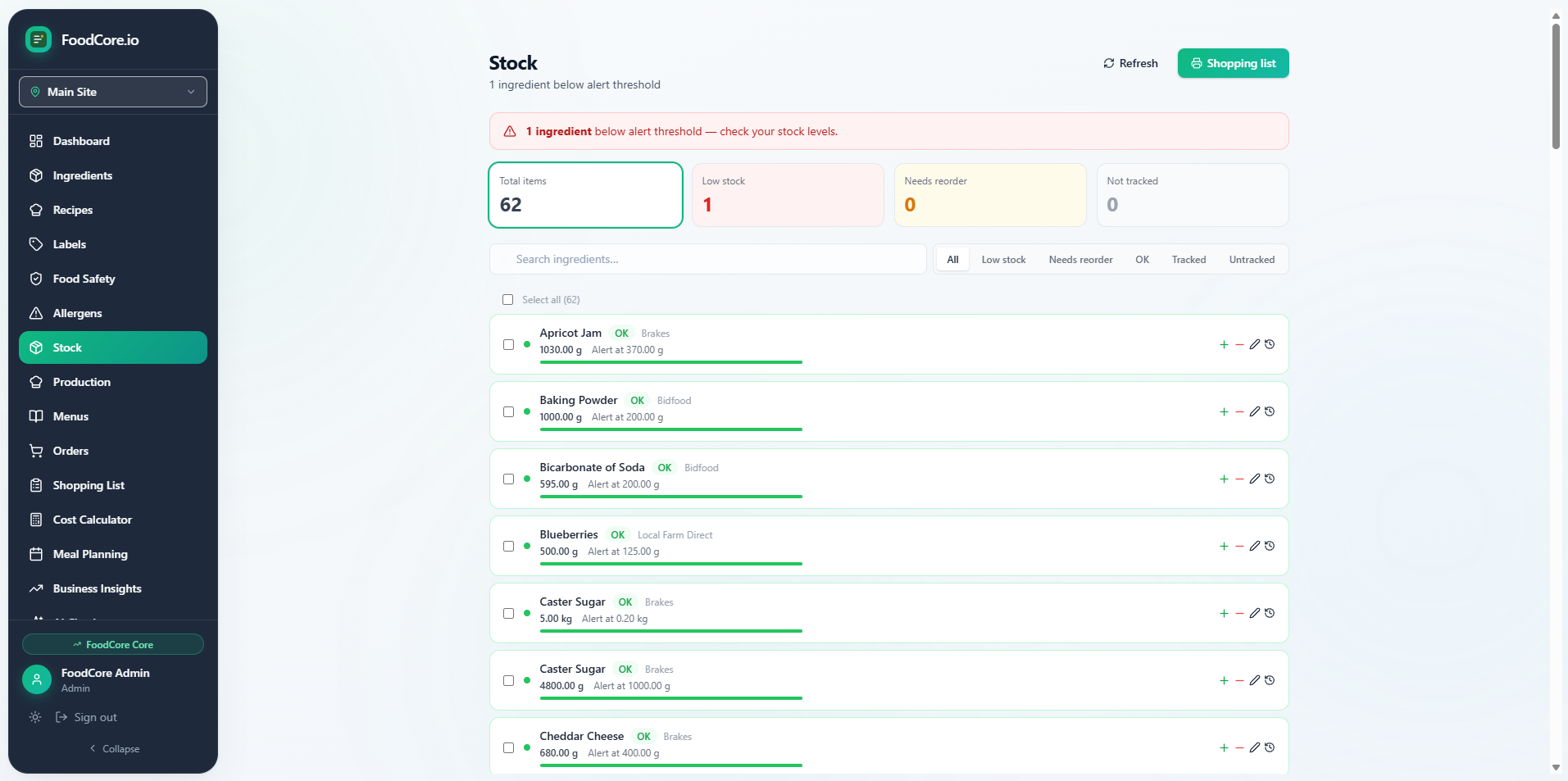
When you mark a batch as produced — say, forty sourdough loaves — every ingredient used in that batch is automatically deducted from your stock levels. Flour, water, salt, starter: the system calculates exactly how much was used based on your recipe, and subtracts it. Your stock levels stay accurate without anyone having to update anything manually. This is the single most important feature in any bakery inventory tool, because it's what makes the stock figures trustworthy.
You can also choose which ingredients to track. If you use a pinch of sea salt as a finishing touch and the quantity is too small to bother tracking, you can switch stock tracking off for that specific ingredient. The system adapts to your workflow, not the other way round.
Adding stock when deliveries arrive
When your weekly flour delivery comes in, you log the quantities received and the stock levels update immediately. If you received less than expected — partial deliveries are common — the system reflects reality rather than the order you placed. Over time, this gives you a reliable picture of which suppliers consistently deliver short, which is useful information when you're deciding where to place your orders.
Low stock alerts that actually work
For each ingredient you're tracking, you set a threshold — the stock level at which you want to be notified that it's time to reorder. When stock drops below that level, the ingredient is flagged on your stock page as needing ordering. This is passive awareness: you don't have to check every ingredient every day. The system surfaces what needs your attention and lets you ignore everything that doesn't.
The threshold can be set as a percentage of your typical stock level, or as an absolute quantity. Either way, you're setting it once and letting the system do the monitoring for you.
Supplier shopping lists generated automatically
Once you know what needs ordering, the system can generate a shopping list filtered by supplier. Instead of writing out your weekly order from scratch, you review a pre-populated list of everything that's low, grouped by the supplier you order it from. You can adjust quantities, remove anything you've already ordered elsewhere, and send the list directly. The process that used to take an hour on Monday morning can take ten minutes.
An illustrative example: how one home bakery owner got control
Consider a home baker running a growing cottage business — selling at two farmers' markets a week and taking custom orders online. She was tracking stock in a Google Sheet she'd built herself: ingredients in rows, delivery dates in columns, manual quantity updates whenever she baked. It worked for the first few months, when she had a small product range and baked twice a week.
As the business grew to thirty products and five baking days a week, the spreadsheet became a source of anxiety rather than control. She'd often arrive at the market to find she'd under-produced a bestseller because she'd thought she had more of a key ingredient than she actually did. Conversely, she was over-ordering anything she felt uncertain about, which meant more waste and more money tied up in ingredients she didn't immediately need.
After switching to purpose-built software, the shift in her mornings was immediate. She set up her ingredient library over a weekend — around sixty ingredients — linked them to all her recipes, and set stock thresholds for the ten ingredients she went through fastest. Within the first week, the stock levels were accurate without her having to update anything manually. Her Monday order was generated in eight minutes rather than the forty-five it had taken before. In the first month, she estimated she recovered around four hours a week that had previously gone to stock-related admin.
What to track and what not to track
Not every ingredient needs to be tracked with the same rigour. High-value, high-usage ingredients — bulk flour, butter, eggs, chocolate — are worth tracking precisely, because errors in these categories have the most impact on your margins and your production reliability. Low-cost finishing ingredients used in tiny quantities — a pinch of flaked sea salt, a dusting of icing sugar — may not be worth the overhead of tracking at unit level.
A good inventory system lets you make that distinction. You decide which ingredients are tracked and which aren't. The default should be to track everything significant and exclude only what's genuinely too minor to matter. As your business grows and your product range expands, you can add more ingredients to the tracked list without rebuilding anything from scratch.
Getting started: the practical first steps
The barrier to starting with inventory software isn't technical — it's psychological. Setting up your ingredient library feels like a big task when you look at the whole thing. The way through is to not look at the whole thing. Start with your ten most-used ingredients. Link them to your five most-produced recipes. Set thresholds for the three ingredients you most often run short of. Then use it for one production week and see what happens.
By the end of that week, you'll have a much clearer sense of how the system works in practice for your operation — and you'll almost certainly want to add the rest of your ingredients immediately, because you've seen what accurate, automatic stock tracking feels like.
The bottom line on bakery inventory
The goal of bakery inventory management isn't to add another system to maintain — it's to remove the mental overhead of constantly wondering what you have, what you need, and whether you're going to run out of something important at the worst possible moment. Good inventory software does exactly that: it makes the mundane stuff automatic so you can focus on the work that actually requires your skill and attention.
You don't need something complicated to do this well. You need something that understands how a real bakery operates — where ingredients are measured in grams, production runs are logged by batch, and the weekly order needs to be done quickly before the morning bake starts. That's a solvable problem, and it's exactly the problem the right software is built to solve.
FoodCore is kitchen management software for small UK food businesses — recipe costing, allergen tracking, stock management and supplier shopping lists, all in one place.
Start free trial →